
Creating a central register list
The Central Register item references a list in SharePoint describing one or more locations. This is known as a central register list.
The central register is a list in SharePoint with one or more columns to help describe a location in SharePoint/Office 365. The columns may be of different columns types (e.g. Text, Number, Lookup, Managed Metadata, People/Groups, etc...). Typically a list would be focused on a particular business system such as project management, Legal Matter Management, Helpdesk, etc... and contain one or more items for each project, matter or helpdesk case respectively.
A central register (list) describing a Project Manage System for example, may have columns such as: Project name, Project description, Project Budget, Project Status, Project Owner, Project Team members, etc... The columns in the list will depend on the system and business requirements.
Required Column/s in the Central Register List
In addition to any columns used to help describe a location, the list must contain a column of type Text or URL for entering a URL to the destination location. If the URL links are referencing locations in SharePoint of mixed types (for example a mixture of: site collections, sites, libraries, lists, Folder, documents sets) a column of type Text must be created for storing the type. The valid values for this column are (must be exact): Site, SiteCollection, Library, List, DocumenetSet, ListFolder, LibraryFolder.
The example central register list below is for a Legal Matter Management System. The list contains a number of columns describing different legal matters, including a column called Matter Location URL. This column contains URL's to the Matter location. In this example, all matter are represented consistently, as SharePoint Sites. Therefore, there is no need for a second column to describe what the Location URL is pointing towards.
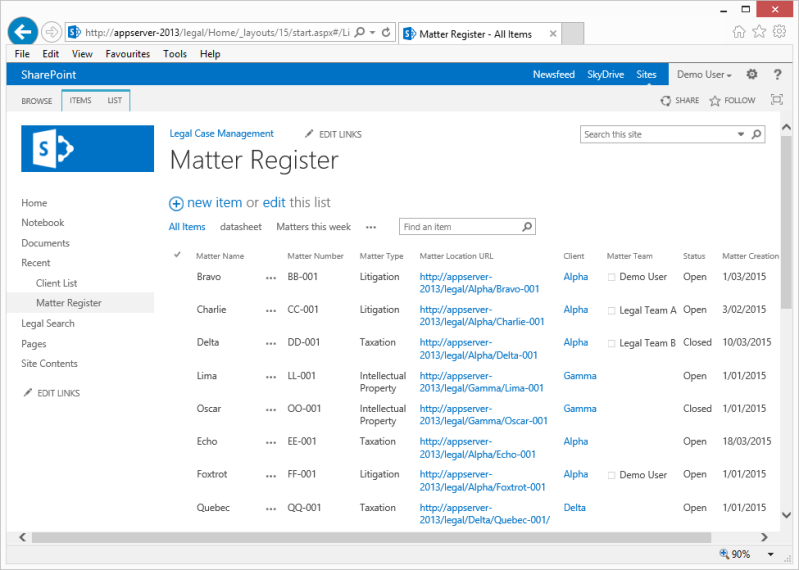
You can create one or more views in the Central Register, ready for selection when create a central register item.